|
"Mold Testing and Mold Remediation"
These two services need to be separate!!
A big conflict of interest does exist in the Mold
Testing and Mold Remediation businesses.
As a consumer you really need to be aware of the
potential conflict of interest that exists between these two separate
businesses and don’t allow yourself to get ripped off.
There are many companies that their main business is the
Remediation of mold and really are not interested in testing first to
see if you really have mold and the extent of it.
Their main objective is to get you to agree to a remediation job
which is typically very expensive and in many cases not even needed.
There are so many horror stories of consumers
getting ripped off because they got talked into jumping right into an
expensive Mold Remediation before having an unbiased Professional Mold
Test performed by a relatively inexpensive actual Certified Mold Tester.
By doing this first you can potentially save yourself from
falling prey to a scam and get taken for your hard earned money.
One example of this can be watched on this CBS
Channel 5 news sting operation. "Watch
This Video"
One More Well Worth Watching !!!
The Hidden Dangers Of Mold Exposure
"Click
Here Now To Watch Video"
Please do yourself and your health a big favor and have your home or
property Professionally Tested by a Certified Mold Tester prior to
speaking to a Mold Remediator and find out just what the real story is
before getting ripped off. For
more information and advice from a Certified Master Inspector please
contact us at 301-534-0669 or Email
Us !!
Facts about Mold and Dampness
Mold grows indoors and outdoors wherever there is a lot of moisture, but you can control mold growth.
There is always some mold everywhere - in the air and on many surfaces. Molds have been on the Earth for millions of years. Mold grows where there is moisture.
Let me help you identify if there are any mold issues in your home and
help you protect your investment and your health. Call
Me Today For A Healthier Life Tomorrow
I heard about "toxic molds" that grow in homes and other buildings. Should I be concerned about a serious health risk to me and my family?
The term "toxic mold" is not accurate. While certain molds are toxigenic, meaning they can produce toxins (specifically
mycotoxins), the molds themselves are not toxic, or poisonous. Hazards presented by molds that may produce
mycotoxins should be considered the same as other common molds which can grow in your house. There is always a little mold everywhere - in the air and on many surfaces. There are very few reports that toxigenic molds found inside homes can cause unique or rare health conditions such as pulmonary hemorrhage or memory loss. These case reports are rare, and a causal link between the presence of the toxigenic mold and these conditions has not been proven.
Mold and Your Health
Exposure to damp and moldy environments may cause a variety of health effects, or none at all. Some people are sensitive to molds. For these people, molds can cause nasal stuffiness, throat irritation, coughing or wheezing, eye irritation, or, in some cases, skin irritation. People with mold allergies may have more severe reactions. Immune-compromised people and people with chronic lung illnesses, such as obstructive lung disease, may get serious infections in their lungs when they are exposed to mold. These people should stay away from areas that are likely to have mold, such as compost piles, cut grass, and wooded areas.
In 2004 the Institute of Medicine (IOM) found there was sufficient evidence to link indoor exposure to mold with upper respiratory tract symptoms, cough, and wheeze in otherwise healthy people; with asthma symptoms in people with asthma; and with hypersensitivity
pneumonitis in individuals susceptible to that immune-mediated condition. The IOM also found limited or suggestive evidence linking indoor mold exposure and respiratory illness in otherwise healthy children.
More information on mold can be found at the CDC Centers for Disease Control and Prevention
Mold and Your Home
Mold is found both indoors and outdoors. Mold can enter your home through open doorways, windows, vents, and heating and air conditioning systems. Mold in the air outside can also attach itself to clothing, shoes, bags, and pets can and be carried indoors.
Mold will grow in places with a lot of moisture, such as around leaks in roofs, windows, or pipes, or where there has been flooding. Mold grows well on paper products, cardboard, ceiling tiles, and wood products. Mold can also grow in dust, paints, wallpaper, insulation, drywall, carpet, fabric, and upholstery.
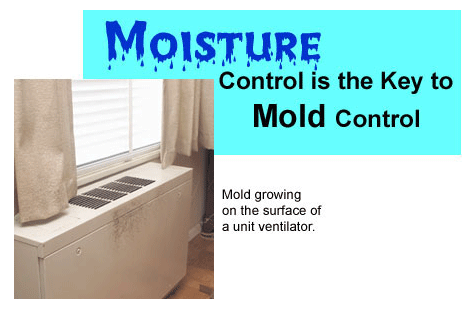
You Can Control Mold
Inside your home you can control mold growth by:
•The key to mold control is
moisture control.
•Keeping humidity levels between 40% and 60%;
•Promptly fixing leaky roofs, windows, and pipes;
•Thoroughly cleaning and drying after flooding;
•Ventilating shower, laundry, and cooking areas;
Our Goal & Promise To You
Committed to providing the most thorough and comprehensive Mold inspection and testing available; using state-of-the-art assessment procedures and equipment to completely evaluate the air quality in your home or business and identify the sources of moisture and water intrusion that may be causing mold growth which can affect the property value and occupants health is my target.
I am committed and determined to provide you with the most comprehensive Mold Inspection and testing available.
This includes but is not limited to identifying the sources of the water
intrusion (s) but also the type of mold that is present in your property.
One of the ways we achieve this goal is by keeping up on all of the latest technologies and methods of proper testing procedures.
We use the latest in available testing equipment. As a Certified
Infrared Themographer we include an Infrared scan of all areas that we
are testing. We also use one of the Nations top leading Laboratories,
EMSL Analytical Inc.
All of these things help us to provide you with a high quality of professionalism and through mold
assessment of your property.
What You Will Get From Me
•All customers will get the peace of mind that they
are living and breathing in the safest air they can be in.
•I offer both Residential and Commercial Services.
•I am fully trained and certified in Mold inspection and Assessment,
and a current member of
International Association of Certified
Indoor Air Consultants (IAC2).
Certification # IAC2-02-0919.
•The services provided are through, efficient, accurate and completed in a timely and professional manner.
•Once the mold inspection of your property is completed you will be provided
with a full report and laboratory findings.
Types & Prices Of A Mold Inspection
There are two types of mold inspections. One type is the
Complete Mold Inspection.
The other type is the Limited Mold Inspection. Both types of mold
inspections are performed in accordance with the Mold Inspection Standards of
Practice of the International Association of Certified Indoor Air Consultants
and the appropriate sections.
"The difference between a Complete Mold Inspection and a Limited Mold Inspection is a
limitation of the non-invasive visual examination of the building. The limited mold inspection
does not include a visual examination of the entire building, but is limited to a specific area of
the building identified and defined by the inspector and agreed to by the client.
The inspector and client prior to the inspection shall agree to the limitation of the visual
examination. As a result, potential sources of mold growth in other areas of the building may not
be inspected".
All mold inspections are designed to give you a fast and affordable way to confirm the existence of mold
and, if
possible, determine the type of mold present in a specific defined area of the
building, as well as the spore counts associated with any molds found.
All mold samplings will conform with all industry standards of practice.
Mold Inspection
Standards of Practice.
Pricing:
1-2 Mold Samples
are $150.00 each
3-5 Mold Samples
are $125.00 each
The 6th + Samples will be $100.00 each
Post Remediation Testing.
This type of testing is done to test the effectiveness of the
remediation efforts and to test whether they have successfully
accomplished what they were intended to do. Remember you always
want a independent third party such as us to do this type of testing and
not the ones that performed the actual remediation process.
The cost for this service varies on what remediation was performed,
so call us for special pricing for this important service.
|